


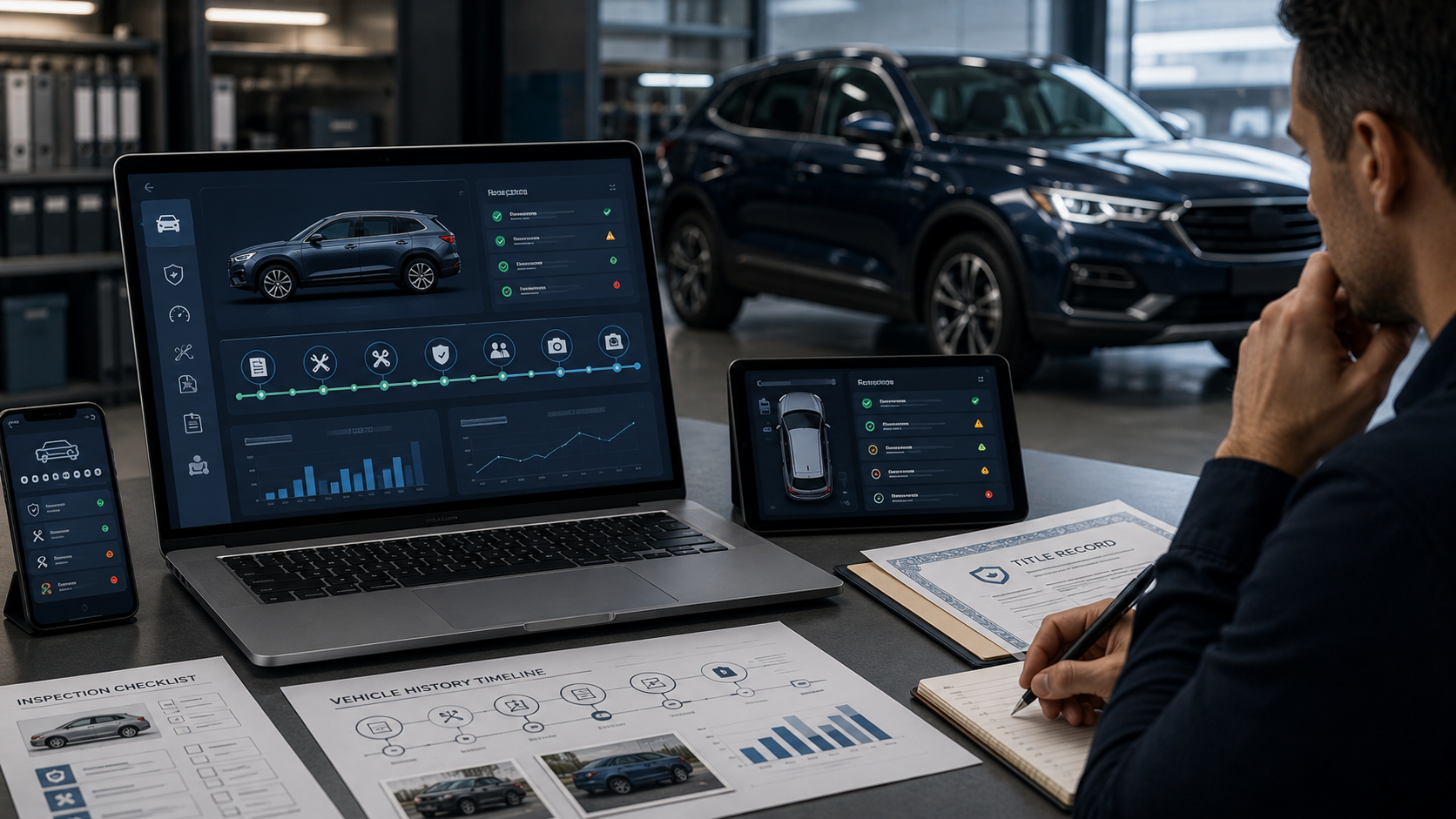
Buying a used vehicle has always involved information imbalance.
The seller usually knows more about the vehicle than the buyer. They may know where it was driven, how it was maintained, whether it was damaged, why it is being sold, and which problems have already appeared.
The buyer often sees only an advertisement, a short test drive, and whatever documentation the seller chooses to provide.
Vehicle history technology is helping reduce that imbalance.
VIN-based lookup tools, recall databases, title records, theft checks, maintenance histories, and digital inspection services can give buyers more context before they spend money or travel to inspect a vehicle.
These tools do not eliminate risk, and they should not replace a professional inspection. Their value is that they help buyers ask better questions earlier in the process.
The VIN Has Become a Starting Point
A Vehicle Identification Number, or VIN, is a unique identifier assigned to a vehicle.
It can help connect records from different stages of that vehicle's life, including manufacturing information, registration activity, title events, recalls, inspections, auctions, insurance records, and certain maintenance sources.
For a buyer, the VIN provides a more reliable starting point than a listing title or seller description.
A seller may describe a vehicle as having a clean history, low mileage, or no major accidents. A VIN-based search may reveal records that support the claim, raise additional questions, or show that more verification is needed.
At VehiclePlainly, the goal is to help consumers understand what vehicle lookup tools may reveal, how to interpret the results, and why no single database should be treated as complete.
The important shift is not that technology can tell buyers everything. It is that buyers can now investigate more before relying on the seller's version of events.
Vehicle History Reports Are Screening Tools
A vehicle history report should be treated as a screening tool, not a final verdict.
A report may help identify:
- title brands
- reported accidents
- possible mileage inconsistencies
- registration history
- auction appearances
- theft records
- recall information
- changes in ownership
- commercial or rental use
- certain service records
However, the absence of a record does not prove that an event never happened.
An accident may have been repaired privately. Maintenance may have been completed by a shop that does not share data with the reporting service. Damage may have occurred without an insurance claim. Records may also be delayed, incomplete, or associated incorrectly.
The correct interpretation is:
“No issue appears in this database”
rather than:
“No issue has ever existed.”
That distinction protects buyers from placing too much confidence in one report.
Odometer Data Can Reveal Important Inconsistencies
Mileage is one of the most important factors in used-car pricing, maintenance expectations, and resale value.
Vehicle history systems may compare mileage recorded during:
- registration
- inspections
- service visits
- auction listings
- title transfers
- dealer inventory updates
A mileage sequence that rises consistently is generally easier to understand. A later record showing substantially lower mileage may require investigation.
Not every inconsistency indicates fraud. Typographical errors, unit conversion, duplicate records, and data-entry mistakes can occur.
Still, buyers should not ignore unexplained mileage changes.
A practical approach is to compare the reported mileage with:
- the dashboard
- service documentation
- inspection records
- previous advertisements
- physical wear on the steering wheel, pedals, seats, and controls
Technology can identify the inconsistency. A careful inspection and supporting documentation help explain it.
Title Records Need Context
A title brand can indicate that a vehicle experienced a significant event or legal classification.
Depending on the jurisdiction, terms may include salvage, rebuilt, flood, junk, lemon, or other designations.
These labels can affect:
- market value
- insurance availability
- financing
- resale potential
- registration requirements
- expected reliability
A branded title does not automatically mean that a vehicle is unusable. Some rebuilt vehicles may have been repaired properly and may be sold legally.
The problem is uncertainty.
The buyer needs to understand:
- why the title was branded
- what damage occurred
- which repairs were completed
- who performed the work
- whether the vehicle passed required inspections
- how the title affects insurance and future resale
Vehicle history technology makes it harder for these events to remain invisible, but it does not evaluate repair quality. That still requires documentation and physical inspection.
Recall Information Is Becoming Easier to Check
Vehicle recalls are another area where digital access has improved the buying process.
A buyer can use the VIN to investigate whether the vehicle may be affected by manufacturer safety campaigns and whether repairs appear to have been completed.
This matters because ownership can change while recall work remains outstanding.
A used-car listing may focus on cosmetic condition, options, and price while leaving safety campaigns unmentioned. A recall check gives the buyer another question to raise before completing the transaction.
The existence of a recall does not necessarily make a vehicle a poor purchase. Many recall repairs are completed without cost to the owner.
What matters is whether the buyer knows about the issue and confirms the current repair status with an appropriate manufacturer or dealer source.
Digital Records Improve Questions, Not Just Answers
The most useful result of a vehicle history lookup is often not a yes-or-no decision.
It is a better list of questions.
For example:
- Why was the vehicle registered in several locations within a short period?
- Can the seller provide documentation for the mileage discrepancy?
- What caused the title brand?
- Are photographs of the earlier damage available?
- Why does the report show auction activity shortly before the current sale?
- Was the vehicle used commercially?
- Have open recall repairs been completed?
- Why are there long gaps in the maintenance history?
A buyer who asks specific questions is in a stronger position than one who asks only whether the car is in good condition.
The seller's willingness and ability to answer may also provide useful information.
Technology Cannot Replace a Physical Inspection
No database can assess every current mechanical, structural, or electrical condition.
A vehicle may have a clean digital history and still have:
- engine problems
- transmission wear
- corrosion
- poor repairs
- electrical faults
- tire or suspension issues
- water intrusion
- neglected maintenance
- aftermarket modifications
A pre-purchase inspection can reveal current conditions that historical databases cannot.
The strongest process combines:
- listing review
- VIN verification
- vehicle history research
- recall checking
- maintenance document review
- physical inspection
- test drive
- independent professional assessment
- verification of ownership and transaction documents
Technology narrows uncertainty. Inspection evaluates the vehicle that exists today.
Buyers Should Compare Multiple Sources
Different vehicle history providers may receive information from different databases and partners.
One report may contain a record that another does not.
Buyers should also distinguish between:
- government or manufacturer sources
- commercial vehicle history providers
- dealer documentation
- service records
- auction records
- seller-provided information
The safest approach is not to look for one perfect report. It is to compare available evidence and investigate conflicts.
A registration record, maintenance invoice, inspection result, and seller statement may each tell part of the story.
Technology is most useful when it helps connect those pieces.
The Future Is More Transparent, but Not Automatic
Used-car marketplaces are likely to become more data-rich.
Listings may increasingly include standardized VIN decoding, recall status, ownership history, inspection data, service documentation, pricing comparisons, and digital condition reports.
Artificial intelligence may help identify inconsistencies across photographs, listing descriptions, specifications, and historical records.
However, more data does not automatically create better decisions.
Platforms still need to explain:
- where information came from
- when it was updated
- what it means
- what it does not prove
- whether a result is confirmed or only a possible match
Without context, a large amount of data can create false confidence.
The most responsible vehicle technology will not promise certainty. It will help buyers understand risk more clearly.
A Better Used-Car Buying Process
Vehicle history technology has changed used-car research from a mostly seller-controlled process into a more balanced investigation.
A buyer can now begin checking a vehicle before visiting the seller. They can identify potential problems, compare claims, estimate risk, and decide whether the vehicle deserves further inspection.
The key is using these tools correctly.
A clean report is not a guarantee. A concerning record is not always a reason to walk away. Every result needs context.
The best used-car decision combines digital research with documentation, professional inspection, realistic pricing, and careful judgment.
Technology does not remove the need for caution.
It gives buyers more opportunities to practice it.